Dagmar Gester is a lens based artist working between Berlin and Sofia. Academically trained in Politics, the artist also has a background working in European Union NGOs, including for those with war trauma. A practicing artist since the early 2000s, Gester has recently turned to a more conceptual way of working with one of her most recent series: Was bleibt (What Remains) which takes the viewer on a journey to the new homeland of Germany, from the perspective of recently arrived refugees. A major publication of this project is due to be published in 2024.
Gester’s work can also be found in collections including Foundation Berliner Stadtmuseum, Berlin and Foundation Deutsches Historisches Museum and she has recently been awarded by the Berlin Senate Department for Culture and Europe for her work documenting the city during the Pandemic. Her studio is in Pankow, North East Berlin. Recently, Nicola Jeffs caught up with the artist to discuss this series and future ideas in her practice.
__________
Nicola Jeffs: Could you explain a little about the series – what motivated it, how did you begin it and what story does it tell?
Dagmar Gester: The series Was bleibt (What Remains) actually marks a turning point in my photographic career. In the sense that it led me to start working exclusively conceptually. In fact, the entire series, including its form of presentation, was conceived in advance. That was in 2015 during one of the so-called refugee crisis in Europe, which was illustrated in the media with the same images over and over again of landing rubber dinghies, people behind or in front of border fences or wandering groups of refugees with or without police escorts.
I told myself I should go and report on what was happening, but I didn’t move. Eventually I realised that these images were too fleeting for me, not lasting, and that they actually say more about how we see things than about the refugees’ experiences. Therefore, I wanted to take the topic of flight and forced migration out of the current commotion and looked for an artistic approach that combines the particularity of individual fate with the universal existential experience.
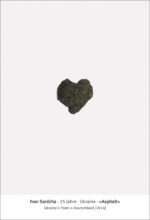
This brought into focus the objects that the refugees brought with them to their new homeland – either because they did not want to leave them behind, or because they acquired existential significance for them on the path of their flight. It is these things that remain and tell the respective story of the loss of home and identity.
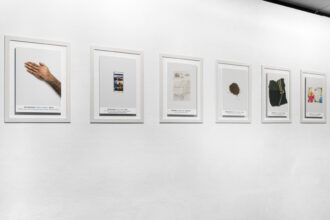
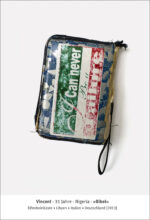
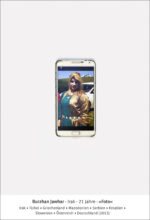
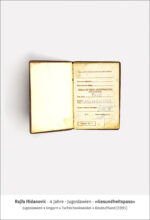
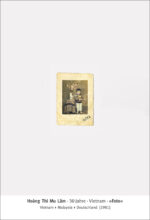
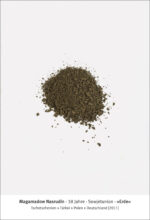
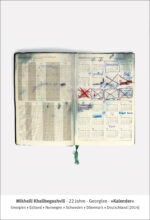
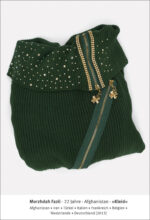
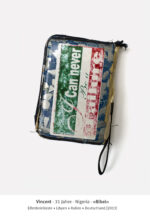
However, these “connection objects” (Vamık Djemal Volkan) are not detached. Since they have acquired a kind of metaphysical meaning only for their respective owners, I have personalised the photographic still lifes. Through short texts, the viewer learns the name of the refugee, country of birth, age when arriving in Germany [last number in brackets] and the route of the object. Gaps suggest that the person either flew across national borders with the object or was hidden and thus does not know the route.
The owners of the objects are therefore not visually present themselves, but are indirectly brought back into the picture through the information. In this way, the personalised objects open up thinking spaces for the viewer and speak directly to them. They are like portraits, for which I have consequently chosen the classic portrait format. The texts are in German, because Germany is the refugees’ destination and the language of their new home.
And, it is these connecting objects that carry them into their new life, because they already had a life.
NJ: How many images comprise the series?
DG: The series, which I started in 2015, was completed in 2016 with 20 exhibits. Since then, it has been shown more than ten times at home and abroad and has been included in three institutional collections. In 2018, I started to expand the series because I felt it was not yet finished. Not only because so many more countries are forcing people to migrate than represented in the first 20 series, but also to include a wider variety of the amazingly diverse “connecting objects”, from clothes to soil, from pastel crayons to carpet and from aquatic plants to cats.
So I have added another 30 works to the 20-part series in the period from 2018 to 2023. It now comprises a total of 50 individual works, which will soon be published in a book of the same name with accompanying texts by KRAUTin Verlag. The book will be bilingual, all German text will be translated into English.
NJ: How does it relate to your past work and wider artistic practice?
DG: In my artistic work, I have repeatedly dealt with our longing for belonging and the obstacles that run counter to it.
Since the early 1990s, I have looked at the upheavals in Southeast Europe. Especially in Bulgaria, where the so-called transition has affected all areas of life. This gave rise to the series of works Abandoned Promises. In my participatory series What Remains, I opened up the radius and with Natura corporum I thematise the dissolution of the habitats we are familiar with. I am currently expanding the view to the planetary dimension of the human home Earth. This saw an evolution from classical printmaking to image-text series and compositions to three-dimensional works and now hybrid works incorporating non-human nature as co-author.
Photography offers me the raw material for this; it is the starting point, not the end in itself. I use it as documentary evidence that fixes aspects of the real in order to then transform and develop them creatively. My particular artistic approach is to withdraw current and controversial contemporary issues from the media hype, distil them to their existential core and give them a sensual and sensuous expression.
NJ: How did you locate your subjects who share their objects – did they offer only one work or did you take photographs of several they brought to you?
DG: First of all, nobody brings anything to me, I always visit the people and their objects. I have developed a simple system for an open air studio. It would seem quite wrong to take the objects to me or to transfer them to a studio for this. And since I shoot on location, the participants can even drape the objects themselves.
I found participants in very different ways, from women’s cafés in refugee homes, where I was able to present my photo project, to communities like the Belarusians who organise themselves in Berlin, to participants from my personal circle of acquaintances. In fact, many participants hardly own anything after their life-threatening escape. Vincent Achebe actually only has his Bible (in his suitcase) or Mussa Saleh, he no longer has any connecting object at all, as he exchanged his wet shorts and vest for fresh clothes on board an Italian rescue ship in the Mediterranean. With others I don’t know, because they know immediately what object they wish to choose. It’s as different as people are different.
NJ: In the current climate these works take on a particular significance – was this a conscious decision.
DG: Indeed, because the experience of losing one’s home is, on the one hand, centuries old, it can affect anyone, and on the other hand, it is an increasingly important issue due to the climate crisis, which is making whole swathes of land uninhabitable. In this respect, it is important for our future coexistence that we (still) settled people find a way of not turning away those seeking help.
I think the rejection that refugees experience is evidence of a deep-seated fear of being uprooted. Refugees and their experiences represent an alternative narrative that challenges the dominant monopoly of settled societies, because they show us the fragility of our seemingly secure existence.
NJ: Did you want to focus on a particular group of refugees?
DG: No, the opposite is the case, because only the diversity and variety of individual fates conveys the common core of this shared experience of loss. The “common core” is that all of them were forced to leave their homes – for whatever reason, be it political persecution, sexual orientation, ethnicity, war or other disasters.
NJ: Your artist statement speaks about the space between the image and frame as being significant – can you expand on this and what you mean?
DG: Well, a classical framing of my photograph would simply miss the point, because it is the object that becomes the work of art. Like Omer Fazil’s dress, for example, which is no longer a piece of clothing that you put on, but is cared for and kept like a mythical object. And now, through my work, it is transformed once again and enriched with an additional meaning. That is why I decided to hang the laminated prints in a separate empty frame, so that there is a gap between it and the picture. This way the object is framed, not my print. Furthermore, the open space adds another layer to the work, as the gap refers both to the temporary exhibition space and to the changing life situation of the participants.
NJ: Do you think adding the names and details of each person alters the image, adds significance to the art work, and impacts the viewer experience?
DG: Yes definitely. Since these objects only have this special value for their owners, they cannot be understood separately from them. Owner and object form a unity. Moreover, the texts speak to the objects and to the imagination of the viewer, who is thus directly addressed. By indirectly bringing the owners back into the picture, the works actually become a kind of portrait. But since the refugees are not visible, they do not take on the role of representing a particular situation, crisis or catastrophe.
NJ: Are there any particular works that stand out for you, or objects that resonated in a particular way when you took the photos? Why? What were they?
DG: No, any work is particular in its own way. In fact, in the long time I have been doing this work, I am always amazed at what this connecting object can be. It can virtually be anything. There is a pair of long-johns in the photographic series, but that is also special because they are handmade. And the three photographs that are part of the complete series are also very special in their own way. They tell a little story of photography. One is a simple print showing a pregnant woman and child just before the escape, another photo is actually a digital image file, taken on Newroz with the date in the picture, and finally an old coloured print made by a professional photographer, which was very fashionable at the time. So if you look closely, you will see that even for us outsiders, each object has its own vibes.
NJ: What do the participants think of the works and have they fed back to you about their experience working with you on this project?
DG: Basically, they have a deep agreement with it, otherwise they would not participate. But it goes without saying that for me, the photo project means something different than for them. I feel gifted, they – that was the feedback – perceived. At every meeting I bring time and attention, and the conversation about the objects goes deep. Tears and laughter are shared. In the exhibitions – of course everyone is always invited, there will still be a party together, and of course everyone receives a book – so in the exhibitions pride is shown above all. Rightly so; they are all survivors.
NJ: Is the series ongoing? How if so do you plan to add to it?
DG: This series will now end with the book publication. But there will be participatory follow up works. One is called Akte and asks about arrival and participation. In German, “Akte” has a double meaning: “Akte” is a file like a foreigner’s file kept on every non-German in Germany, but it is also the plural of “Akt”, which is a nude photograph. This hints at what it is all about: a kind of political nude photography.
About 10 million adults who live and work in Germany for a long time still don’t have the same civil rights as Germans because of their non-German citizenship. I address this democratic deficit in an artistic way by touching on where status discrimination can supposedly be overcome: in love. I say “supposedly” because for the lovers this situation actually means a life on hold, a life of tension, uncertainty, fear, dependence and humiliation.
My work shows skin-scapes of affection and togetherness of these couples. I photograph the intimate contact of one skin with the other skin, which is wounded by the relevant paragraphs of the Aliens Act. I understand the series as political nude photography: because the skin is, after all, the largest sexual organ. And skin colour is also a political issue.
The image files are printed on fibrous material, which dresses the exhibition space like a smock. The printed material is then treated with a tattoo machine that burns the paragraphs of the foreigners’ files into the depicted skin. In this way, the blank and bare, the originally undescribed human skin is overwritten by the ascriptive contents of their files, which thus become sensually tangible.
NJ: We’ve spoken about your series of works made during the pandemic when we last met – can you tell me a little about these and your experiences walking the empty streets of Berlin to make them? What motivated you?
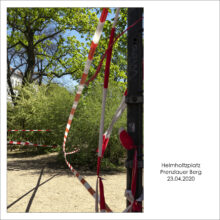
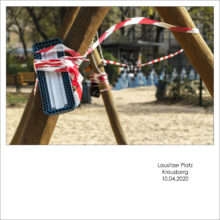
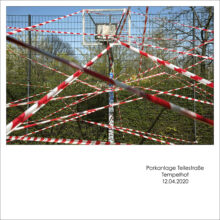
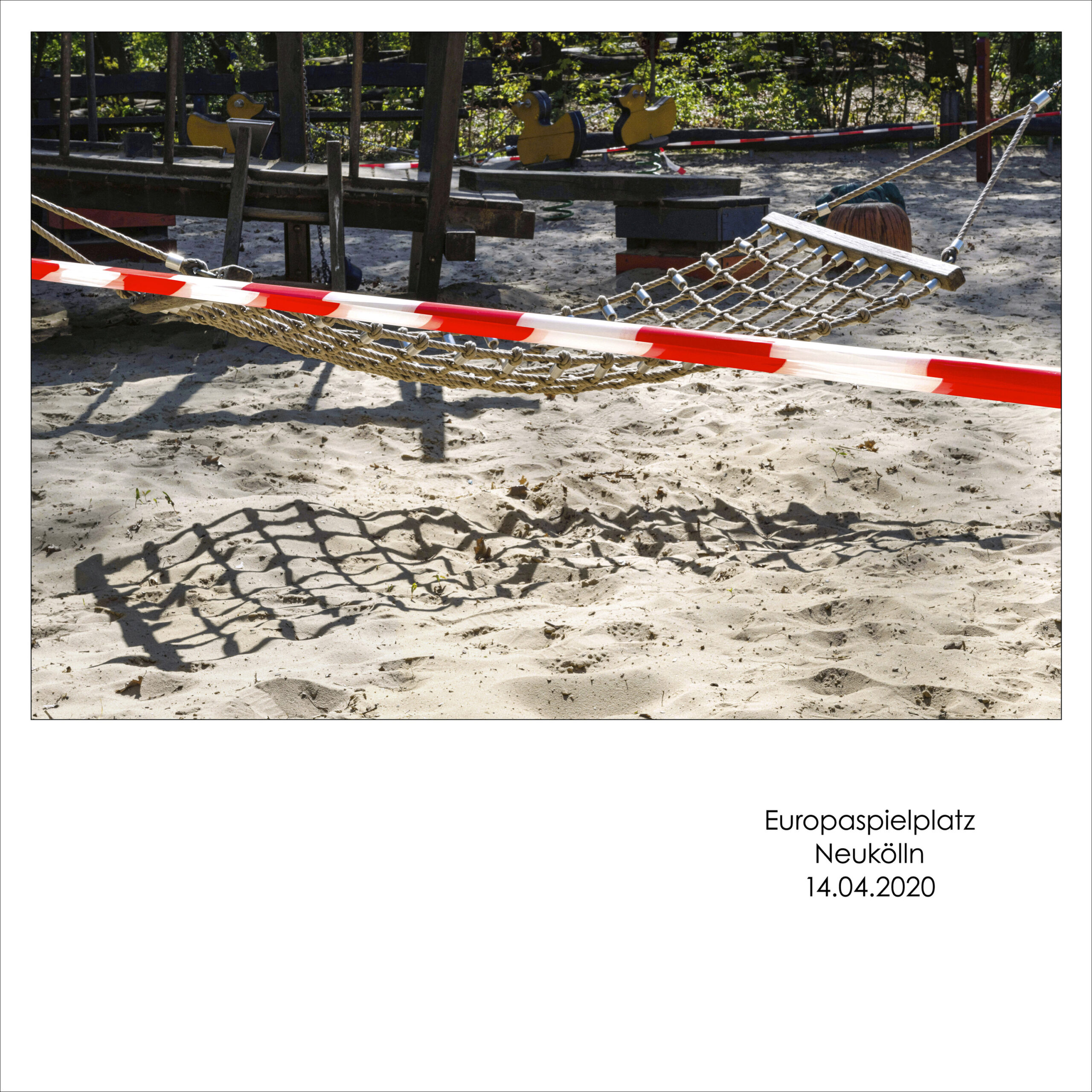
DG: You’re talking about the series Signals? Well, compared to the hectic Berlin life of these days, I have to admit that it was pleasant working – apart from the fact that the toilets were also locked during this first lockdown. The city was strangely quiet and I also had this unexpectedly quiet time to deal with this changed life situation. But the changed appearance of the familiar city was not an artistic subject for me at first. It was only when I learned that the spring of 2020 had an absolute record of sunshine hours, at least in Berlin, and that climate change was thus back on stage, that I began to process the special circumstances artistically. In addition, the particle-free air created an artificial outdoor studio light and these red and white barrier bands were unintentionally staged by the optimal illumination from the sun.
So much for my motivation, you know the result. I think the new virus teaches us what climate change has long been telling us before: our vulnerability. It forces an awareness of our own physicality, which consequently was also the target of all measures to contain the pandemic: proximity, contact and community. Everything that constitutes both our humanity and society. And this was demonstrated by the barrier tapes that transformed the Berlin cityscape during the first lockdown in spring 2020.
The ribbons caused a kind of re-measurement of the city. In their three-dimensional plasticity, an architecture of the space in between emerged. In a very unique way, it captured our inner search for new orientation on the outside. Faking the aesthetics of Polaroids, the photographs are given a white border. Like instant pictures, they are labelled, but not with personal notes but with information about place and time. The street and place names, from Europaspielplatz to Germaniapromenade, add another layer and communicate with the photographs. The works are like souvenirs, they are images of memory and at the same time reminders. They become afterimages of the Corona pandemic and lasting signs of an increasingly threatening world.
NJ: What are you working on next?
DG: I have just developed a new concept with which I have applied for scholarships. I strive for a further development in form and content by leaving the purely anthropocentric perspective. In continuation of my occupation with our need for a home, I am now asking about the homeland of the human species, which is in the process of destroying the basis of its existence. My focus is on the soil, not only because the topsoil feeds us, but also in a metaphysical sense as the place where we belong.
I plan to photographically relate human physicality and soil life and even include soil flora as co-authors. These will be hybrid works for which I have started experimenting with photographic papers by exposing them to the natural elements before printing, thus predetermining the later printed image. At the same time, I am also trying out other substrates such as wood or stone. Because in order to convey the becoming and decaying not only visually but also haptically, suitable forms of artistic expression could be found in this way. So, this is a whole new adventure; the outcome is open.
But back to the beginning, to Was bleibt (What Remains): The series of the 20 exhibits from 2016 is fortunately on permanent display in the city centre of Bochum at the “Forschungs-und Behandlungszentrum für psychische Gesundheit” of the University of Bochum. A small selection also hangs in my studio, you are always welcome. You can find me in the Atelierhaus Prenzlauer Promenade in Berlin-Pankow. Just let me know when you are in Berlin. There are also various events planned around the book release, please do stay in touch with me, preferably via my monthly newsletter, which is also available in English.
__________
Dagmar Gester is a lens-based artist working in Berlin and Sofia, whose works have been exhibited and published internationally. Images shown above are from Gester’s series, Was bleibt (What Remains) and Signale.
Nicola Jeffs works in visual culture and communications with institutions, museums, festivals, arts organisations and biennials.