


Marianne Bjørnmyr (b. 1986) is a Norwegian artist, living and working in London where she received her MA in Photography from London College of Communication in 2012. In her practice she works with research based photography, concerned with perception of the photograph’s approach to reality, where the presentation of the photograph is set up against our understanding, interpretation and generated perception of imagery. Marianne is currently completing a FATHOM residency at Four Corners in London, where she is working on her project Your Penumbra.
Marianne’s work has been exhibited internationally including Daniel Blau’s 5 under 30, The Norwegian State Exhibition Høstutstillingen and The North Norwegian Art Exhibition. She has also been awarded the Juvenarte and Jansons Scholarship amongst others art grants from The Norwegian Arts Council and Norwegian Visual Artists. Below, Francesca Marcaccio Hitzeman speaks with Marianne about her recent practice.
__________
Francesca Marcaccio Hitzeman: Your Penumbra is an ongoing work to be completed through the FATHOM residency at Four Corners in London. That project along with your previous series Shadow/Echoes has focused on the perception of the photograph’s approach to reality. What is it about that topic that interests you?
Marianne Bjørnmyr: For me, there is an interest arising from how photography has been made to be seen as an appropriate tool to document reality, when the medium itself has such an arbitrary relationship to the world. The photograph holds a leading position in the transmission of reality, closer than all forms of documentation, in its likeness and in its quality of revealing objects as they are. We have these collective ideas that what we see in photographs shows an imprint of reality – created by systems of knowledge and recognition. We witness photographs to depict the things we know around us with great accuracy and as such trust that photographs offer a precise reference to the subject. This makes us trust in photographs that show us things that we have never seen, and it makes me think of all the responsibilities the photograph holds.
We have certainly become more conscious about how photography is being created and presented, but at the same time it seems to be a topic that interests a lot of artists at the moment. Your Penumbra is in its own way examining the qualities of the photograph, but I also see it more as an investigation into the many different ways photography is being used as a measure and report on the world, and learning more about who or what holds the power of the ability to capture reality.
FMH: Could you talk a little bit more about Your Penumbra and how these images were chosen, what attracted you to the astronomer Henry Draper and his story?
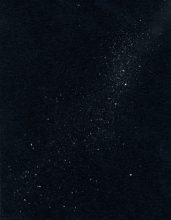
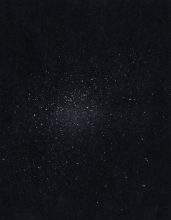
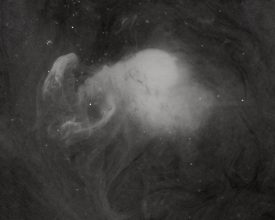
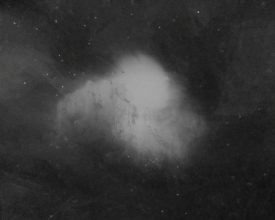
MB: Henry Draper was the very first to photograph the Orion Nebula after spending years refining his self built telescopes. This being in 1880, his photograph was amongst the first photographs ever showing us something that could not be seen with the human eye. Followed by other photographic developments like microscopes and xrays, invisible phenomena suddenly took place in a visual form. Draper’s first image showed a white cloud on a black sky, one year later he had perfected his photographic techniques and the image already looked sharper and clearer than the one before. At the time, eminent scientists claimed that even though Draper’s work was a great achievement, the photograph would never replace the human eye to see the stars. Regardless, this image was part of the start of outer space photography, which has in this very short time progressed into depicting something that no human being will ever be able to see with the naked eye. Draper’s work was the starting point of the photograms I made for Your Penumbra– looking at this tension between what the camera captures and what we see with our eyes, and at the same time how we perceive what we are presented.
FMH: In your statement you mention that the photographic glass sculptures, the photographic images and film come together to examine the fascinating and misleading specifics of the photograph. Could you give us some examples of the specifics that you are looking to examine?
MB: For me, I feel this claustrophobic impossibility of never being able to experience these starscapes and distant galaxies that the Hubble and other telescopes now are presenting to us, it is just simply too far away for any human being to ever see for real. These images, not taken with a camera, but created using data from electromagnetic waves captured by the telescopes, showing us crystal clear details and mesmerising constellations – I see this similarity to my own stardust photograms, although not as extravagant, they are actual depictions of stars, but then again they are not. The project sort of refers to its own title, Penumbra, a part of a shadow that is not quite a full shadow.
The components are in their own way coming together in different ways, they examine different specifics of the photograph and depiction in different ways, and sort of respond and communicate with each other giving clues and comments to each other.
FMH: How does the sculpture play into this? How did you approach each structure, were their specific shapes significant?
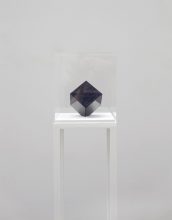
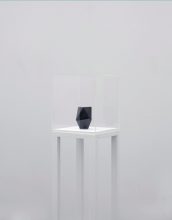
MB: The sculptures act almost as an ironic reference to the photograms – it is mirroring the “real thing”, but we can never be sure of what the real surface is and what is a replica of it. The sculptures present a closed up abstract view of a starry sky – despite the object’s opacity viewers cannot see the inside of the sculptures very clearly. When looking into the sculptures from different angles the viewers will recognise that the reflective surfaces are only part of a larger system of repetitious depictions, hard to recognise. There is no regular geometric logic to the shapes – if you analyse the cosmos there will be hundreds of patterns created out of their position – some claiming these to be codes or secret maps. The sculptures hold a slight reference to this phenomenon of wanting to believe in something and wanting to see, and make a reference to things that are there.
FMH: Were you reading any literature or have you been inspired by any other visual art when making these images?
MB: I have been reading some classics with interesting views around photography and reality, like Barthes and Sontag, as well as Rosalind Krauss, David Green and Joanna Lowry, Hal Foster and Mary Ann Doane. Lots of this reading lead me to look to earlier conceptual artists such as John Priola, Ed Ruscha, Robert Barry etc. that are all pointing to the ambiguity of the photograph as a means of representation. For all of these artists, the performative aspect came into play, in a way refunctioning the “reportage quality” of the photograph. Further, I became more aware of photographs that don’t even claim to be a witness to particular events, but a reproduction of objects and scenes, as well as the platforms that we find authority in. It is not just the technical qualities or the performative aspect of the creation of the photograph that plays a role in the way a photograph is being read but also our education and understanding of what we are being presented.
At the moment there are so many contemporary visual and installation-based artists that inspire me in so many different ways; Haris Epaminonda and Daniel Gustav Cramer, Broomberg & Chanarin, Taryn Simon, Gerard Byrne, Peter Watkins, Freddy Dewe Matthews, all in their provoking reactions in using categorised documentation and the viewers’ (possibly naive) insight into them.
FMH: Astronomy is like a precious stone still rough, an ancient field of research but continuously in evolution, very tangible reality, with a long lineage of dreams and hopes and expectations to meet. What does Your Penumbra stand for in the astronomy field, and what does it mean for you?
MB: You mention this tangible reality, this is what interests me the most; there is so much speculation linked to astronomy photography, it’s a field that will never be fully explored. For me, the fascination is very much linked to the fact that I will never be able to see these detailed views of planets and other galaxies myself, I relay and depend on visual depiction to understand what these places look, or may look like. It’s a matter of feeling closer to all that there is out there; when I was making the star dust photograms I held the star dust in my hands thinking that this is closer to the stars than I’ve ever been before. I keep thinking that this action translates to the audience in a sense; when looking at the images you will be standing inches away from parts of an actual star.
In the field of astronomy there are so many questions and metaphors, so many things to dwell on. My work does not actually show any photographs of outer space, it all comes down to the act of observing and how we perceive. Art has its own way of bringing attention to the implications of depiction; it is quite liberating being able to produce and present work without being responsible for the accuracy in the representation of what there is.
FMH: Aside from their precise and highly accurate references, your photographs contain a pictorial approach, meticulous and patient virtuosity in composition, a thoughtful palette of light and shadow and juxtaposing tones. Could you tell me more about your creative process; how does an idea take on its final shape?
MB: I think I have to say I am quite drawn to the order in which things come together, much preferring the accurate rather than the inaccurate. Like most people, I am also very drawn to aesthetics, and with astronomy especially having such a visual appeal, it seems to be automatically replicated in the end products.
I usually have a quite strong vision of the final work to start with, and although I know it will always change, I keep referring to that point throughout the process. I am often starting out quite rough in the sense of photographing or editing, and then refining the work until I find the suitable visuals and a method of communication. It is something that I sort of just have to do to find a balance in the work.
FMH: I would like to know more about your methodology. How does your work usually evolve? What kind of strategies do you put in place in order to translate your research visually and negotiate the gap between practice and research?
MB: Detailed background research is the basis of any of my projects; at the same time I pick up visual cues along the way. The photographing itself usually tends to be quite a short part of the process, while the methodology often develops fully in between the creation and establishment of the presentation of the work.
However, whilst making Your Penumbra the research has very much been done through creating the actual work rather than creating work based on previous research. Twisting and stretching, refining the work over and over again, I am learning and discovering new things as I go along. This work is more physical and experimental then my previous work, and is revealing new details during the process that changes the original research in a way.
It is always a great challenge to translate research into something visual, and the work is becoming more and more about the presentation and context rather than the images themselves. I am finding myself absorbing more and more of what seems to be a trending development, being more interested in sculptural works and objects, as if there is something more that wants to be added.
FMH: Could you tell me a bit about the logistics of your image making, in terms of your camera and printing?
MB: There are few standards in terms of photographing or printing in my work. When I do photograph I’ll go for classic analogue photography, but I am finding myself more and more interested in pushing boundaries of the creation and presentation of the photograph, breaking away from my standard processes. At the same time the finished works seem to end up with similar visuals, so there must be something there that attracts me to certain aesthetics.
I am also, through my other current works in progress, finding myself focusing more on different kinds of printing, making sure each work has the possibility of being presented in the way that suits its specifics: screen printing, traditional photographic printing, lithography, risography, and also in different presentation outlets: books, prints, sculptures, objects and so on. I am sometimes feeling a bit divided in the way that my works end up looking quite different, but at the same time they seem to just come together in a way that suits the specific background and research. In Your Penumbra for example, there is no photographic camera involved, but there are lots of links to the photographic image; photographic paper and photograms, video work and mirrored reflections.
– interview by Francesca Marcaccio Hitzeman
_________
For further reading: www.mariannebjornmyr.com