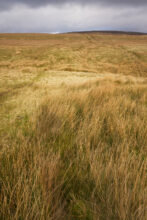
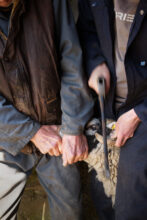
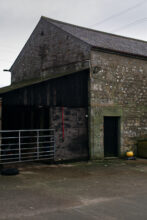
For this ongoing project, I am photographing in rural Lancashire on a corridor east of Lancaster and west of a lonely hill called Grit Fell. I am interested in the multifaceted relationships between the people who live and work below Grit Fell and the places that provide the contexts for their lives. I am also curious to explore how I, as an outsider, relate to what I experience.
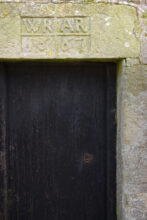
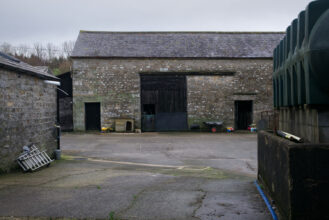
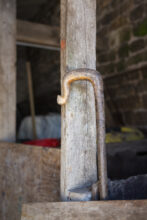
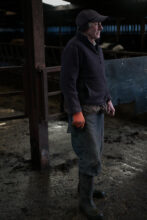
Initially, I did not know anyone in the area, but a friend had mentioned growing up on a hill farm below Grit Fell. He was willing to put in a word for me with his father, Dick Gorst, and a few days later I phoned Dick to ask if I could visit his farm. “Oh, aye!” he said, “have you time on Friday?” When I arrived, the first thing I noticed was the old stone barn, which dominates the farmyard. On the date stone above the door, I could just make out ‘1667’. I remember thinking that the Dutch had only reached the Cape of Good Hope fifteen years before and it seemed like a very long time had since passed.
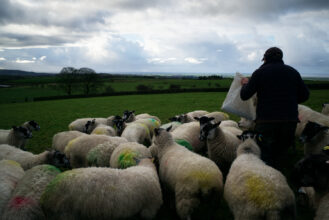
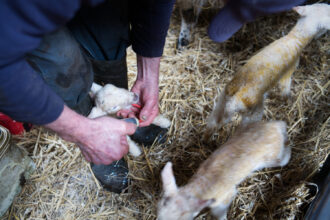
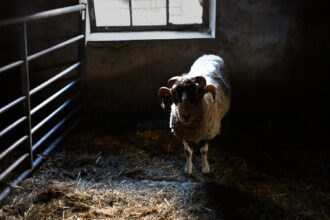
Dick breeds Bluefaced Leicester and Swaledale sheep and his purebreds are at the top of a three-tier system. The Leicester rams and Swaledale ewes that he sells are crossed to produce Northern Mules, hardy and healthy sheep suited to the harsh northern upland climate. Mule ewes are then crossed with lowland rams like Texel to produce lambs for the meat market.
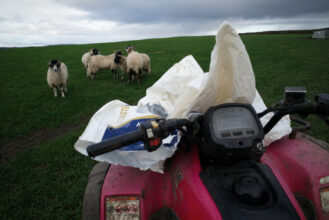
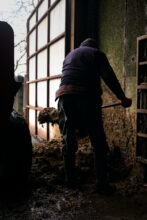
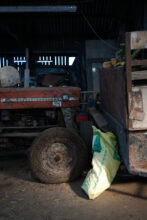
Dick also provides winter housing for cattle to other farmers. On a December afternoon, I watched him clear his cowshed and we drifted into the topic of change. He used to think that his mother, who had lived past a hundred, must have witnessed an incredible amount of change. Now he thinks that he, who is in his seventies, may have seen even more. When he took over the farm from an uncle, he walked the fields to tend his sheep. These days, it is hard to imagine hill farming without a quad bike.
To illustrate the enormous change that humans have wrought in a very short time, the ecologist Wes Jackson imagines compressing the time since higher life appeared on Earth, some 750 million years ago, into a single year [*]. In this imaginary timeline, at ten to midnight on New Year’s eve, agriculture is developed. And only in the last three seconds of the year, fossil fuel starts turbo-charging the changes that Dick had alluded to. The date on Dick’s barn, 1667, is just shy of three seconds to the New Year in Jackson’s timeline. It no longer feels that distant.
[*] Wes Jackson, “The Earth in review: the rise, role, and fall of soil,” In Nature as Measure, Counterpoint, 2011.
__________
Johannes Pretorius is a South African photographer based in the United Kingdom. His work is experiential, takes a personal perspective, and draws on the traditions of documentary and fine art photography. He wants to discover why he finds a subject captivating, and aims to communicate this to others. Topics of interest include boundaries and reflections on being an outsider.
Works from ‘Below Grit Fell’ will be exhibited at The Storey, Lancaster, from 23 Sept – 5 Oct. 2022. For further viewing: ajpretorius.com @_ajpretorius