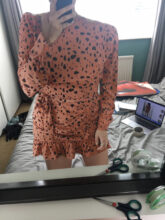

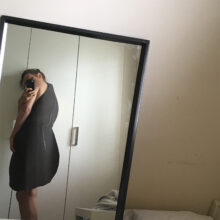
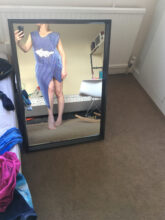
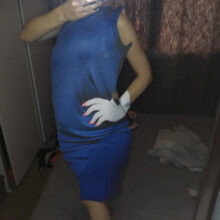
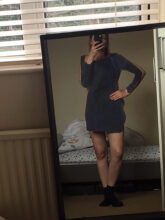
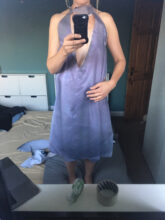
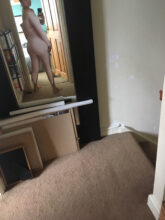
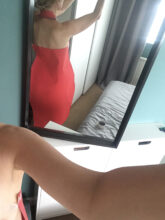
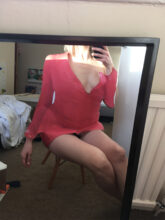
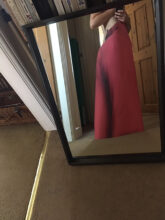
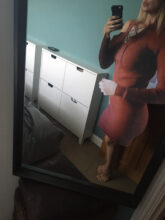
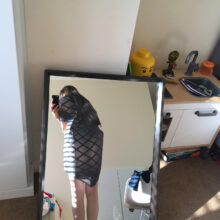
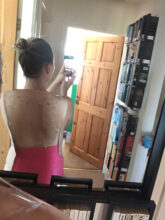
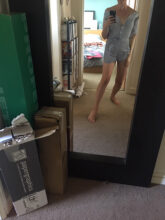
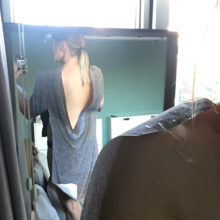
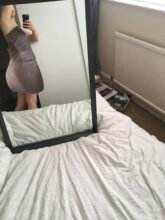
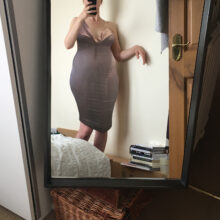
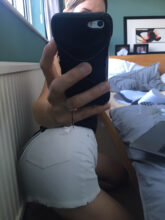
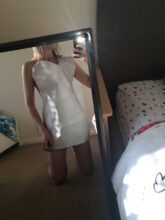
Using search terms such as ‘Boohoo sized 10’ and ‘Misguided bodycon’, I scroll through eBay looking for selfies, or rather, images that look like selfies, which feature women, modelling second-hand clothing, that they are ostensibly selling to other women.
I am usually presented with the following listings of images: outfits hung on coat hangers attached to the fronts of wardrobes or dangling from the architraves of bedroom doorways, garments fitted to dressmakers’ mannequins, and items laid on surfaces such as beds, table tops, and floors. Amongst these are some, but not many, self-representations made by women. From here, I can make my image selections.
My choices are informed by the following: I am looking for garments photographed in such a way that the bulk and shape of the body is exaggerated and augmented by the camera’s optics and the seller chosen angle of view; and I look out for poses that appear to embody an idea or fantasy. Furthermore, the photographs must be DIY, that is to say, seemingly made by the seller, with a mobile device, and the women must be positioned within the domestic site of the home.
Once I have found a digital photograph that fits my criteria, I take an image grab, enlarge it to life-size, and then print it onto proofing paper using my large format inkjet printer. Following this I lay the print on my living room floor, cutting around the paper garment, removing it from the printed body of the wearer and the backdrop, sometimes leaving in a hand, an arm, or a fleshy back. Once I have removed the two-dimensional outfit from the rest of the print, I fit the paper apparel to my body, securing it with sticky tape. The tape is a precarious choice, it easily comes unstuck and once it has peeled off it refuses to stick to my body as effectively as before. But the tapes transparent nature is useful as it doesn’t block out the point at which the print touches and fixes to my skin. Proofing paper is also useful here, not only because of its relative cheapness in monetary terms, but because it is malleable, enabling me to fit it (although crudely) to the contours of my body.
In my bedroom, in my home, and in front of a mirror – to echo the framing and contexts featured in the original image – I photograph myself modelling the eBay seller’s outfit (albeit in photographic paper form) using my iPhone. The original photograph informs my reenactment – kept on my phone screen, laptop or iPad as a reference point. In this sense, the camera-phone image becomes an uncanny fantasy mirror, with the offline self attempting to model the figure on the screen. A selfie that is at once me and not me.
That is to say, whilst the representation literally features me, it does not reflect my body per se, rather what I perceive on screen is my body merged with that of another body. And I see and experience myself as I have never seen or experienced myself before.
__________
Moira Lovell is an artist-researcher undertaking PhD studies at the Royal College of Art. The title of her research is ‘The Image as a Template for Posing’. In her practice-led research, Moira uses photography and video, to react and respond to what she sees online: following selfie-making tutorials, re-enacting other people’s selfie poses, ‘smizing’, saying “prune” to the camera-phone, and deconstructing and reconstructing the language of the selfie with the help of a speech coach. Yet, her examination of self(ie)-portraiture can be differentiated from others, in that she creates an ‘after-image’, that is to say, she draws from the digital, makes analogue, and then returns to the digital, in an albeit compromised form which is close enough, but not quite. The resultant works are somewhat out-of-joint and in this sense provide a choreography that occurs IRL. Moira is particularly interested in the material manifestations of the labour involved in constructing oneself for/as an image and also the future impact of the ‘selfie’ on the physiological and psychological welfare of society as the body gets closer and closer to the photographic surface, emulating it, and becoming – through lenses and filters, photo-ready make-up and cosmetic surgery – a kind of “living-image”.
For further viewing: