

Statement
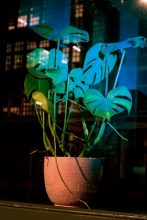
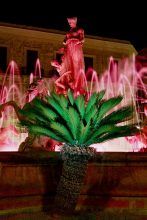
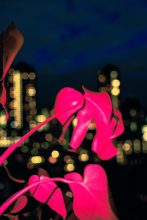
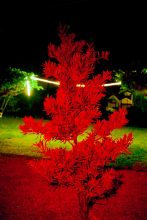
The deeper the night, the dimmer the light. As people leave work and return home to sleep, their tropical houseplants — bathed in the colours of the night — are still there behind the windows. I wander the streets at night and turn on a dazzling spotlight to illuminate the plants that captivate my eyes. I use the dark blue of the sky, the lights of a fairy, the decorative lighting of an Italian fountain, and tropical plants with unusually bright colours to illustrate my version of a many-layered botanical dictionary.
In an article entitled ‘Why an Illustrated Botanical Dictionary?’, Takuma Nakahira wrote, “The most important function of an illustrated dictionary is to refer to the object in a clear and straightforward way. It sets aside all nuance and feeling.” This critique, written in 1973, also proposed that photography should be taken and edited as if the photographer was compiling a botanical dictionary. For Nakahira, his photographic ideal was based on the neutral qualities of illustration methods in a botanical dictionary. My ideal, on the other hand, is to disclose the agitating messages hidden in clean and quiet botanical images.
The media and my work in the lifestyle industry constantly exposes me to the images and ideals of a contemporary lifestyle. Visuals in lifestyle magazines aim to demonstrate an ideal living style to feed their readers’ desire for a better life. Looking through such magazines, I cannot help but notice that a select few types of tropical plants are more frequently spotted than others. I see the plants in the magazines, in my friends’ homes, and in my Instagram feeds.
For me, it is unsettling to see that certain plants are celebrated more than others. Even more unsettling is that these tropical plants are cultivated in apartments — either in the temperate climates of Western Europe or in sub-tropical Taipei — whose environment does not provide the adequate conditions for the tropical plants to flourish. When I look through a magazine and see a beautiful apartment featured with tropical houseplants, I always wonder why the image implies a tasteful and ideal living space; after all, the plants are not in their ideal growing environment. If the tropical houseplant is a symbol of the tropical dream in the temperate European countries, what do they represent when they are cultivated in a tropical country such as Taiwan?
I was visited by similar unsettling feelings at the Royal Botanical Gardens, Kew. When one enters the iron-framed greenhouse and is immediately surrounded by a dense collection of beautiful plants, it is normal to feel dazed and confused; after all, these plants originated from the tropics. With its own temperature and humidity control, the steamy and foggy greenhouse is like a tropical dream come true. Botanical gardens are fascinating yet isolated Shangri-Las. They are also the perfect example of European colonial conquest; the gardens showcase a great variety of plants collected since the 16th century from around the world. In botanical gardens, cacti and orchids are grown under the same roof, ignoring the unnatural juxtaposition which places plants from different continents side by side.
The unsettling feeling I experienced may be my empathy for these tropical plants who have never been able to settle since the 16th century when European explorers started to colonise the tropics and moved the botanicals from their native homes. While collecting exotic plants began with discovery and exchange, the plants were later used for academic and medical studies in the European botanical gardens built during 16th to 17th centuries. The taxonomic system introduced in 1753 by Swedish naturalist Carl Linnaeus in The System of Nature made it possible to uniformly and efficiently document the botanic specimens the collectors gathered in their exploration.
In the meantime, the rich and the privileged built their own greenhouses to domesticate tropical houseplants as a way to show off their power and wealth; only the powerful and wealthy were able to provide a well-maintained space for these exotic plants. In 1851, the first World’s Fair took place at the Crystal Palace in London and showcased a great diversity of products and specimens from around the world. No longer were science and medicine the primary reasons for collecting and cultivating tropical plants indoors; the new focus was to use the plants to create an exotic, luxurious, and graceful atmosphere.
The cultivation of tropical plants has become continually more approachable and popular for middle-class households following technological advances in heating and lighting since the 1940s. Every home can afford the dream of living in the Garden of Eden, and everyone can have their tropical dream come true. Magazines now illustrate the tasteful lifestyle to readers by publishing pictures of apartments adorned with tropical houseplants.
Carl Linnaeus’ faithful approach to documenting specimens reflects Takuma Nakahira’s perception of botanical dictionaries’ peculiar neutrality. In botanical illustrations, plants often appear as isolated botanical fragments on a blank page. As straightforward as this type of illustration seems, the images carry more political information than they at first suggest. Colonial European visual culture was closely linked with politics; documentations and depictions of new territories and exotic creatures provided the rudimentary information necessary for administrators to recognise the New World. As naturalists began to formulate new classification systems to organise and document their world, they became aware of their newfound power; by creating these systems, they developed an extraordinary authority to order nature. The white spaces in botanical illustrations show decontextualised specimens, thereby creating a standardised image of the plant. Likewise, images in lifestyle magazines set standards for their readers. When potted tropical plants are placed in a bright and clean home, the whiteness of the room effectively mimics the white space that surrounds botanical illustrations; in both situations, the story behind the plants is decontextualised.
Hundreds of years following the first intercontinental transplants, tropical plants are still foreigners and need artificial protection to stay alive in an unfit environment where they do not belong. While these plants are now found everywhere across Europe, they are taken for granted and will never become the comfortable locals. I took the images used in the work during my travels in England, Taiwan, Italy, and Portugal, locations rich in colonial history and its associative botanical history. Using coloured lights, I highlighted the plants which triggered my empathy and pointed out significant truths. When the city falls asleep, these tropical plants may be able to shed the role they play in the ideal lifestyle. Within the city, they seem suspicious, as if they may have more to say than what they express as a beautiful picture in a lifestyle magazine.
Artist Biography
Crystal Y. F. Pan (b. 1989) is a photo-based artist. After 5 years working in the magazine industry, she recently completed her master’s degree from the Graduate School of the London College of Communication (UAL) where she received a Photomonitor commendation for her final degree project.
Her images blends saturated colours and controlled compositions to explore the state of alienation within contemporary settings. Born and based in Taipei, Taiwan, where the densely populated city is close to the Pacific Ocean and high altitude mountains, her practice reflects the features of her birthplace and revolves around the complex relationship between people, city and nature.
For further viewing:
Website: crystalpanyf.com
Facebook: https://www.facebook.com/crystalpanphoto
Instagram: @babeinacorner