
Images and text by Stephen Clarke
Often, we see what we want to see, not going beyond the surface. It is the task of a good detective to go beyond appearances to piece together a hidden narrative. When I was a teenager in the 1970s, American television shows provided moving pictures from another country, where people spoke the same language as me yet were distinctly foreign. California, in particular, became known through appearances while everyday reality remained hidden beneath the surface. The Californians lived in an exotic land. I perceived that they did things slightly differently, and I tried to understand their lives.
The television series Columbo—a British favourite—was based in southern California. Lieutenant Columbo, a homicide detective played by Peter Falk, was a shabby little guy who seemed more suited to the New York Police Department than that of Los Angeles. A blue-collar figure, he investigated the lives of rich Californians. He was clearly an oddity, apparently awkward in his environment, his trademark raincoat unexpected in the Californian heat. At the beginning of each episode, viewers were made witnesses to the details of a murder, including the identity of the murderer. In these inverted mysteries Columbo’s role wasn’t to reveal to the audience ‘whodunnit’, but instead to uncover all of the overlooked details from everyday life that pointed to the crime. The scene, staged by the perpetrator, is gradually unravelled by the attentive eye of the detective, making the audience look closer at what has been presented.
In the summer of 1986, I moved to southern California. As a new arrival to San Diego I had to stand back to see where I was; this made me less aware of the details and more conscious of the bigger picture. Nothing was extraordinary in this landscape except me. A British accent along with bumbling naivety made me stand out, just like Falk’s fictional character. My relocation from Britain to California was a rite of passage. A preliminary visit in the winter of 1985 was my first experience of flying – a fifteen-hour journey that I undertook alone to the other side of the world. On landing it was not the heat that struck me but the Californian light, in contrast to the grey climate I’d left behind. The contrasts that I kept uncovering underlined the out-of-place nature of my time in this city, as did the exchange, over time, between my preconceived knowledge and actual experience. As a student, my exposure to the work of the twentieth-century American photographers, Walker Evans, Lee Friedlander, and Lewis Baltz had added to my sense of familiarity with the landscape. In my early twenties I was a pre-packed resident who knew my place, and with this ‘foreknowledge’ I took photographs.
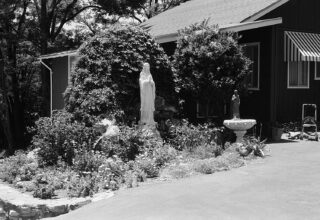
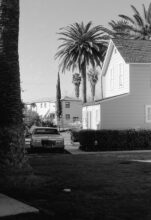
The methodology that informed my picturing of San Diego may have been a premeditated investigation that would confirm my expectations, but this topography was also shaped by where I resided and the employment I gained. San Diego County is segregated into different communities, stretching from affluent La Jolla on the coast to the less-desirable areas in East County. As a less-wealthy immigrant I lived in the latter, in a one-bedroomed apartment in El Cajon. Surrounded by palm trees and with access to a communal swimming pool, this did not seem a miserable ghetto, although John Baldessari, another ex-resident of San Diego, had indicated the presence of the southeast county ghetto in his Ghetto Boundary Project (1969). In an episode from Columbo these habitats would be reserved for fill-in scenes and the minor characters; and as a working class policeman, it is in these neighbourhoods where the detective would most likely have had his home, but this is not revealed to the viewer. Equally unrevealing, my photographs did not document my own domestic existence—this is noticeably absent—however, my contact sheets are filled with the outside of houses and apartments, and with their yards and drives.
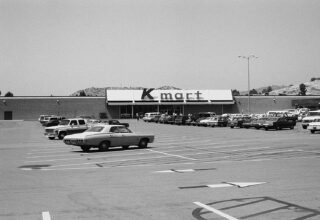
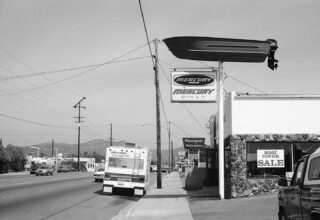
The separated communities of San Diego are joined together by the freeways that act as the main arteries of the city. Freeway 8 connects East County to the coast and would be my main route across the region, while Freeway 5 runs from the Mexican border to, and beyond, Los Angeles. To travel to work and get around San Diego, I needed a car. What had been unnecessary in Britain became a necessity in southern California. My car was a small blue second-hand Toyota Corolla, less distinct than Columbo’s French manufactured Peugeot 403, but just as foreign in a land noted for its outsized automobiles. I worked at a number of retail outlets—a 7-Eleven convenience store, the discount store Pic ‘n Save selling wicker baskets, and the photography minilab, Fromex, processing holiday snapshots—located mostly in strip malls, spread throughout the suburbs. The detective and the photographer take circuitous journeys that help familiarize them with their subjects; neither Columbo nor I followed the classic, linear, road-trip format.
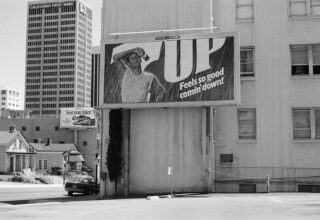
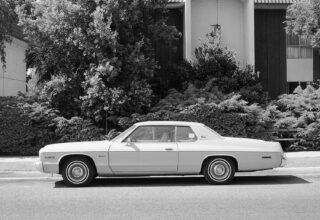
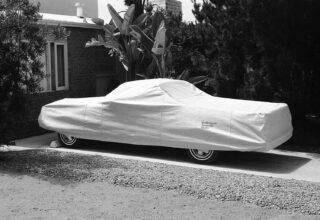
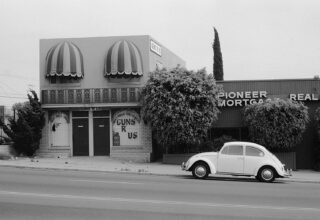
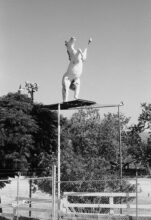
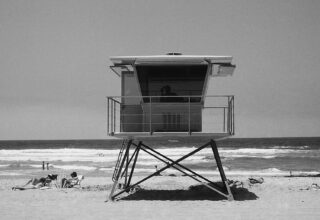
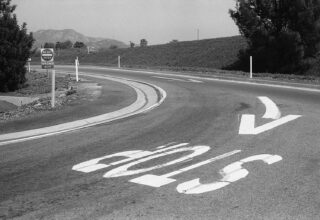
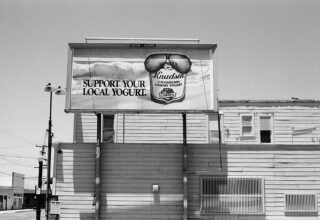
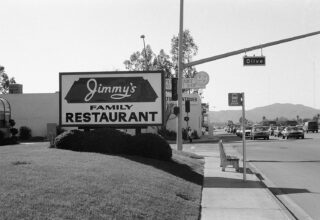
Driving around I followed the signs, which in turn I caught with my camera. This sensitivity to signs in this landscape had its beginnings in looking at Ed Ruscha’s pictures of Los Angeles while I was a student at art college in South Wales. I had the illicit pleasure of laying out the complete concertina spread of his photobook, Every Building on the Sunset Strip (1966), along the corridor of the student halls of residence, allowing me to conceptually travel the distance. Familiarity with other books by this ‘Information Man’ guided me, on arrival in southern California, to produce my own typologies—a pseudo-forensic compiling of uncertain evidence by photographically collecting mailboxes, palm trees, signposts, cars in profile, and cars covered to protect their paintwork from the rays of the sun. There are things missing from the compilation, noticeably swimming pools and sun-bathed occupants.
It is the lifestyles of the rich Californians—his opponents in the programme—that Columbo focuses his eye upon. They are part of the mystery that he has to solve. How do these people live in such places? As a resident alien, it was something that I was trying to understand about my new habitat. Californians are not the subject of my photographs, when they appear they are small figures in the scene. To some extent this is the nature of the environment; this landscape is not crowded and so people are distant, but it also reflects my own personal distance. There were characters that I worked alongside such as Mattie, the Navajo Indian; the Eastern European woman, manager at Pic ‘N’ Save; and the customer at the 7-Eleven who came into the store every hour, throughout my graveyard shift, to get a carton of milk and one dollar in quarters. Each of them now plays their own bit part in my memory. A more significant encounter happened one day when I received a telephone call at my apartment. The call was from John Baldessari. It was the only contact that I had with him while I lived in California; we would finally meet ten years later in England.
The call from Baldessari was ‘just one more thing’ in this narrative. In the summer of 1987, I left San Diego to return home to Britain. The one-year as a resident alien was a transitional period that still has resonance. Thirty-three years later, I take on the identity of the detective to sift through the evidence. I work through black and white negatives and unclear memories, and the landscape is less familiar. Geographical distance, as well as time and age, reduce visibility. At the end of his life, the actor Peter Falk was also disconnected from his creation; he could not remember playing Lt. Columbo as Alzheimer’s disease stole his memory of this role. Mirroring the inverted crime drama, the trajectory of my story moves from mediated foreknowledge to actual experience, and lastly to questioning through a reinvestigation. I arrive again in a land both known and unknown.
__________
Stephen Clarke is an artist, writer and lecturer based in the North West of England. He studied at Newport College of Art, South Wales (BA Fine Art, 1986) and Winchester School of Art, University of Southampton (MA Contemporary Art and Theory, 1996, and MA Fine Art Printmaking, 2004). His writing and practice encompass collage and photography.
For details of the exhibition ‘Alien Resident: San Diego Photographs 1986 – 1987, by Stephen Clarke’ at Contemporary Art Space Chester (CASC).
Mike Pinnington has written about Stephen Clarke’s San Diego Photographs for The Double Negative
Café Royal Books have published four San Diego books by Stephen Clarke